AI's Next Bottleneck Isn't Compute—It's Confidence
The AI industry has been obsessed with the wrong question. 'Can we build enough compute to keep up with demand?' is no longer the constraint. The new bottleneck is confidence: knowing whether what you built actually works, reliably, under conditions that matter. Swarmcheck is built for exactly that shift.
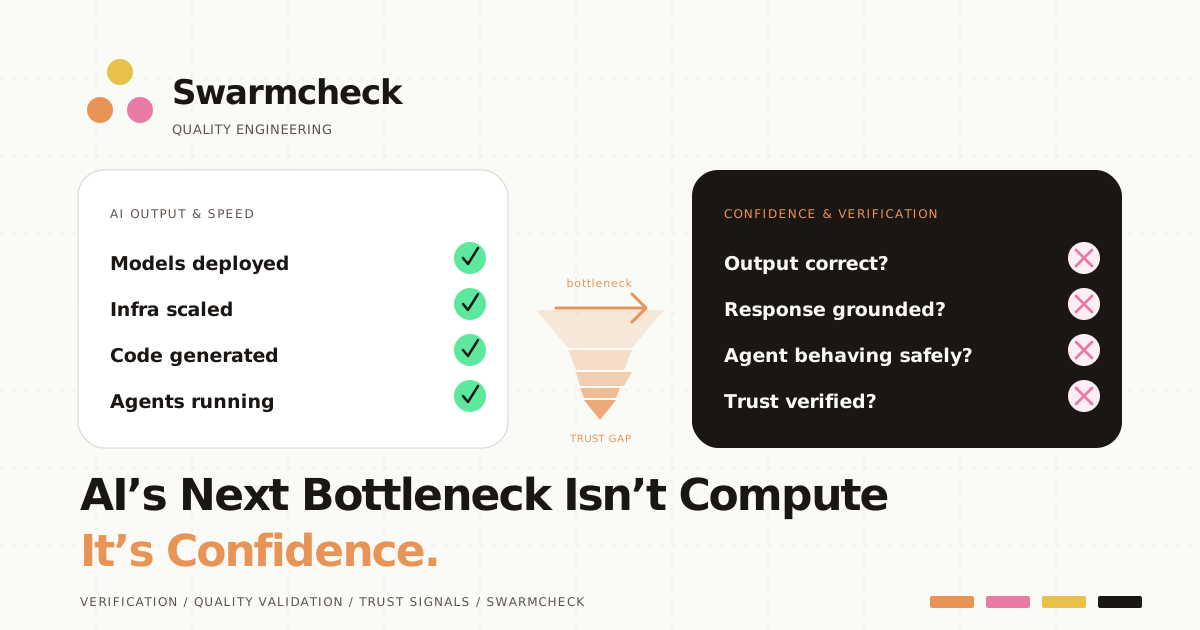
For the past several years, the AI industry has been focused on a deceptively simple question. Could teams build AI fast enough to keep up with demand?
Model releases accelerated. Inference infrastructure scaled. Developer tools multiplied. Coding agents arrived and began shipping features in hours that used to take weeks. Every week brought a new benchmark, a new capability, a new reason to believe the bottleneck was supply—of compute, of models, of tooling.
That question is increasingly the wrong one to ask.
Building AI is no longer the hard part. Trusting what you built is.
As AI deployments mature—as agents move from demos into production, from chat interfaces into autonomous workflows, from novelty into infrastructure—teams are running into a different kind of bottleneck. One that no amount of additional compute resolves. The new constraint is confidence: the ability to verify that an AI system behaves correctly, reliably, and safely under the conditions that actually matter.
Output Is No Longer the Constraint
The speed at which AI systems can produce output is genuinely extraordinary. Coding agents scaffold features in minutes. LLMs generate documentation, summaries, responses, and analyses at volumes no human team could match. Multi-agent workflows now execute tasks that used to require specialist knowledge and days of human coordination.
Industry data reflects this. Google has reported that 75% of its production code is now AI-generated. The median enterprise operates in a codebase predominantly written by machines. Output velocity has been permanently altered.
The same data reveals the other side of that acceleration. Production incident rates have risen in direct proportion. Seventy-eight percent of organisations report a measurable spike in production failures tied to AI-generated code. Eighty-two percent have suffered at least one major production failure in the past six months attributable to AI output. The volume of what is being shipped has scaled. The confidence in what is being shipped has not.
This is the verification gap. And unlike the compute gap, it does not close by adding more resources.
A Familiar Transition
The technology industry has been here before. The history of computing is a history of bottlenecks migrating up the stack. Hardware became abundant, so the constraint moved to software. Software became cheaper to build, so the constraint moved to distribution. Distribution became a solved problem, so the constraint moved to trust—security, reliability, compliance.
Each transition looked the same from the inside. The industry kept optimising for the old constraint long after it had ceased to be the limiting factor. It took a generation of incidents and failures to redirect attention toward the new one.
AI is following the same arc. For the first phase, the question was 'can we make models that work?' For the second, it was 'can we deploy them at scale?' The third phase—the one underway now—is 'can we actually trust them to do the right thing, consistently, in production?'
Running a model is a compute problem. Trusting a model is a verification problem.
Why Standard Checks Miss the Real Failures
The instinct when something fails is to add more tests. Run more evals. Expand CI coverage. Tighten the assertion library. These are the right moves for conventional software. For AI systems, they address the wrong failure mode.
Standard tests verify the container, not the contents. Does this endpoint return a response? Does this component render? Does this workflow complete without an exception? For deterministic systems, correctness and function largely overlap. If the code executes correctly, the output is probably correct.
AI systems break this assumption entirely. A chat agent can hallucinate a refund policy with total confidence while returning a 200. A voice agent can book the wrong itinerary while latency metrics look healthy. An autonomous agent can call the correct API with unsafe parameters while the CI pipeline turns green. The container passed. The judgement failed. Standard tests cannot tell the difference.
| What standard checks measure | What AI confidence actually requires |
|---|---|
| Does the endpoint return 200? | Did the agent return a grounded, accurate answer? |
| Does the UI render without errors? | Did the agent complete the user's actual intent? |
| Do unit tests pass? | Did the agent maintain context across a multi-turn flow? |
| Is the build green? | Did the agent refuse correctly without over-refusing? |
| Does coverage look healthy? | Did the agent's behaviour drift after the last model update? |
| Does the health check succeed? | Did the agent call tools safely, not just correctly? |
These are not complementary checks. They test for entirely different things. The left column tells you the plumbing works. The right column tells you whether the intelligence inside the plumbing is trustworthy. As long as teams treat the left column as sufficient evidence of the right, they are shipping confidence gaps into production.
The Agentic Shift Makes This Urgent
Agentic AI changes the stakes of the verification problem. A chatbot that gives a wrong answer is a bad experience. An agent that acts on a wrong answer—booking a flight, cancelling a subscription, submitting a form, executing a financial transaction—is a production incident. The gap between 'said the wrong thing' and 'did the wrong thing' is the gap between a quality problem and a trust problem.
Agents also introduce verification challenges that do not exist for simpler systems. They operate across multiple steps, which means a failure can occur anywhere in a chain and may not surface until the end. They invoke external tools and APIs, which means failures can have real-world consequences. They maintain memory and context, which means a subtle drift in early reasoning can compound into a major failure in late execution. And they are probabilistic, which means the same input can produce different outputs across runs, making deterministic test suites structurally insufficient.
The Tirias Research forecast cited in the broader AI infrastructure conversation projects the average agentic user consuming 40 times as many tokens as a conventional chat user. As workloads become longer-running and more autonomous, the blast radius of a trust failure grows proportionally. This is not a risk that scales linearly with usage—it scales faster.
Confidence Is Becoming the Product
The first phase of AI cloud was about access to compute. The second was about access to capable models. The emerging phase is about access to verified, trustworthy AI behaviour—and the infrastructure that makes verification possible at scale.
This shift is visible in how teams talk about their AI systems. The question is no longer 'does this agent work?' It is 'how do I know this agent works?' The former is a build question. The latter is a verification question. And the verification question does not have a good answer yet for most teams.
Manual QA cannot keep pace with agentic deployment velocity. Human reviewers cannot cover the combinatorial space of inputs, states, and contexts that a production agent encounters. Self-evaluation by the same model that produced the output is structurally compromised—research consistently shows model accuracy collapsing when the evaluating system shares the same assumptions as the producing system.
The most dangerous failure mode in AI is not a model that gets things wrong. It is a model that gets things wrong confidently, and a team with no way to know.
What teams need is external, independent verification: a system that exercises their AI product the way real users do, under realistic conditions, and produces structured evidence of what worked, what did not, and how confidence is trending over time.
From Self-Service Output to Self-Service Confidence
Cloud computing transformed software development because it reduced the friction of getting infrastructure. A developer could provision resources in minutes and begin building immediately. The industry then went further, abstracting not just the hardware but the operational overhead: managed databases, serverless functions, observability platforms, security layers.
Each abstraction had the same effect. It moved teams closer to the outcome they cared about and further from the underlying technology they did not want to think about.
AI quality verification is following the same path. The first generation of AI testing required teams to build their own evaluation frameworks from scratch—custom evals, hand-crafted test cases, bespoke assertion logic, manual review pipelines. The resulting systems were expensive to build, expensive to maintain, and often abandoned under shipping pressure. The second generation moved toward eval frameworks that standardised the structure but still required teams to author and maintain the cases. The emerging generation—the one teams actually need—is one where the platform does the verification work, not just the verification scaffolding.
That is what self-service confidence looks like. You describe the flow that matters. The platform exercises it, evaluates the results, surfaces the failures, and tracks confidence over time. You focus on building. The platform focuses on proving.
How Swarmcheck Closes the Gap
Swarmcheck is built for the verification phase of AI. Its approach rests on a core architectural principle: the system that produces AI output and the system that verifies it must be independent. Closed-loop evaluation—where the same model judges its own work—reliably overstates quality and understates risk.
A Swarmcheck agent runs the flows that matter in your AI product. It exercises your chat agent, your autonomous workflow, your voice assistant, or your support bot under realistic conditions, with realistic inputs, across the states that users actually encounter. It captures structured evidence at each step: what the agent said, what it did, whether the output was grounded, whether the behaviour matched what was expected.
- Quality checks run on every deployment, not just before a release—so drift is caught when it is introduced, not when a user finds it.
- Multi-turn flows are exercised end-to-end, not just as isolated prompts—so failures that compound across steps are visible before they reach production.
- Tool calls and external interactions are verified for safety and correctness, not just confirmed to have occurred.
- Confidence scores trend over time, so you can see whether your AI system is becoming more reliable or less reliable as your models, prompts, and product evolve.
The goal is not to replace human judgement. It is to give human judgement something to work with: structured, reproducible evidence of how an AI system behaved, under what conditions, and with what level of reliability.
The Real Inflection Point
The AI industry is approaching an inflection point that has nothing to do with compute. Models are capable enough. Infrastructure is available enough. The tooling to build AI products exists in abundance. The constraint now is trust—and trust, in AI systems, is an engineering problem.
Teams that treat verification as an afterthought will ship faster in the short term and slower in the long term, as production failures erode user trust, generate rework, and force the manual review that automation was supposed to eliminate. Teams that treat verification as a core capability—one that scales with their deployment velocity, exercises their most critical flows, and gives them structured confidence before every release—will compound that advantage over time.
The question the AI industry should be asking is not 'could we build enough compute?' It is 'can we trust what we built?'
The most successful AI teams will not be those who ship the fastest. They will be those who know what they shipped.
Swarmcheck exists to give teams that knowledge. If you are shipping AI products and your verification strategy has not kept pace with your deployment velocity, start here.
Point an agent at your worst flow.
The fastest way to find out if Swarmcheck fits your team is to run it against the flow you trust the least.