AI QA audit template: how to test LLM apps, agents, chat, and voice before release
A practical AI QA audit template for engineering, QA, and product teams testing LLM applications, AI agents, chat agents, voice agents, and AI red team risks before release.
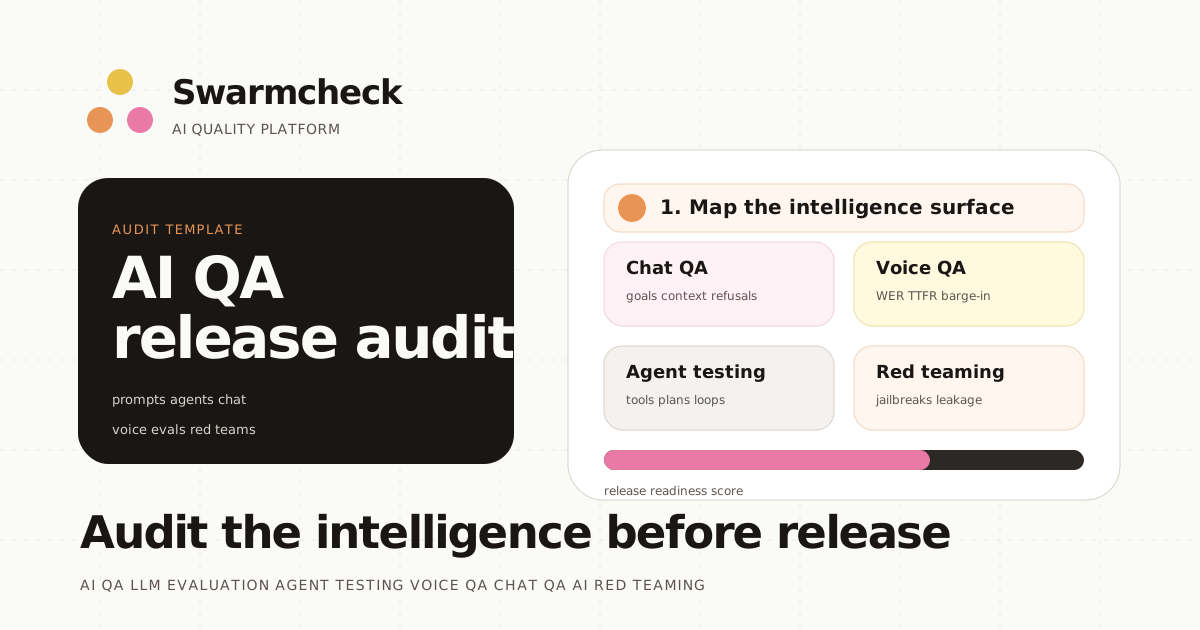
Most release checklists still assume software behaves the same way twice. AI products do not. A prompt can pass yesterday's sample, fail today's user, recover on the next run, then leak context after a retrieval change.
That is why AI QA needs an audit template, not just a test case template. The goal is to inspect the intelligence layer: prompts, model behaviour, context use, tool calls, voice timing, chat memory, security boundaries, and production drift.
Traditional QA checks the flow. An AI QA audit checks whether the flow still makes good decisions when the answer is probabilistic.
What is an AI QA audit?
An AI QA audit is a structured review of whether an AI-native product is safe, useful, grounded, observable, and ready to ship. It combines AI testing, LLM evaluation, prompt testing, AI agent testing, chat agent QA, voice agent QA, and AI red teaming into one release-readiness view. If you are new to the discipline, start with the Beginner's guide to AI QA.
The audit is not trying to prove that every response is identical. It is trying to prove that behaviour stays within acceptable boundaries across realistic, edge-case, and adversarial scenarios.
Step 1: map the intelligence surface
Start by listing every place where the product makes or delegates a judgement. This becomes the audit scope. Do not stop at the chat box. Many AI failures happen one layer away from the visible assistant.
- Prompts and system instructions, including hidden policy prompts and routing prompts.
- Retrieval and grounding sources, such as documents, knowledge bases, user data, and search results.
- Multi-turn memory, saved context, session handoff, and long-running task state.
- Tools and actions, including API calls, workflow triggers, updates, messages, and purchases.
- Voice-specific layers, including speech recognition, interruption handling, latency, and audio quality.
- Security boundaries, including jailbreaks, prompt injection, data leakage, and unsafe tool use.
This is where Swarm Testing adds value. Scripted paths cover expected usage. Swarm testing sends agents through the product like real users, including confused users, impatient users, and users who change direction mid-flow.
Step 2: choose AI QA metrics that match the interface
A single pass rate is too blunt for AI quality engineering. The right metric depends on what the AI is doing. A voice agent, chat agent, and autonomous workflow agent fail in different ways.
| Audit area | What to test | Useful metrics |
|---|---|---|
| Chat agent QA | Multi-turn goal completion, hallucination, refusal behaviour, tone, and context retention. | Goal completion rate, hallucination rate, refusal accuracy, context retention. |
| Voice agent QA | Speech recognition, first response timing, audio quality, interruption, accent and noise robustness. | WER, TTFR, MOS, barge-in success rate, accent robustness. |
| AI agent testing | Tool choice, parameter safety, plan adherence, recovery, escalation, and loop behaviour. | Tool correctness, step efficiency, plan adherence, loop detection. |
| LLM evaluation | Grounding, helpfulness, citation quality, brand tone, regression from prompt or model changes. | Rubric score, regression delta, drift rate, release readiness. |
| AI red teaming | Jailbreaks, prompt injection, data leakage, retrieval poisoning, unsafe actions. | Jailbreak success rate, leakage rate, injection resistance. |
Step 3: build golden datasets and prompt tests
Golden datasets turn AI QA from opinion into regression evidence. They should include successful examples, known failures, boundary cases, adversarial attempts, and real production questions that previously caused support tickets.
- Include normal, ambiguous, edge-case, and malicious inputs for each critical workflow.
- Record the expected outcome, not an exact answer string, unless the product truly requires one.
- Score with calibrated LLM-as-judge rubrics and spot-check the judge against human review.
- Run the suite before prompt changes, model upgrades, retrieval changes, and new tool releases.
As discussed in the metrics section above, the audit should measure semantic quality, not only syntax. The AI QA maturity model is a useful next read if your team is moving from prompt testing into AI quality engineering.
Step 4: run monitoring and AI red teaming before production teaches you
Pre-release evaluation is necessary, but it is not enough. AI behaviour changes after launch because users, documents, prompts, and model providers change. Your audit should define production monitoring for drift rate, regression delta, alert volume, latency, and failed critical journeys.
Add security testing for AI before release. Test direct jailbreaks, indirect prompt injection in retrieved content, attempts to extract system prompts, cross-user data leakage, and unsafe tool calls. AI red teaming is not a final ceremony. It is a standing regression suite for adversarial behaviour.
How Swarmcheck AI turns the audit into a quality system
An audit is only useful if it becomes repeatable. Swarmcheck AI starts with AI-driven QA testing in Phase 1, including auto-generation, self-healing, and browser automation. Phase 2 adds swarm testing. Phases 3 and 4 layer in voice agent QA and chat agent QA. Phase 5 centralises AI quality for evaluation, observability, and improvement. Phase 6 adds AI red teaming and security testing for AI. That is why Swarmcheck is an AI Quality Platform, not only AI in testing.
See how Swarmcheck connects autonomous QA, semantic evaluation, evidence, and release confidence.
Read the Swarmcheck guide to evaluation methodology, metrics, and quality signals for AI products.
Go deeper on rubrics, judgement, and evidence for agent evaluation.
Swarmcheck AI was founded by Naveen Bhati to close a practical gap in the market: teams can now ship AI features faster than they can prove those features are trustworthy. You can connect with Naveen Bhati on LinkedIn.
If your team is preparing an AI release, use this audit template against the highest-risk workflow first. Then book a demo with Swarmcheck AI or read the AI QA white paper to see how the audit becomes a living quality system.
Point an agent at your worst flow.
The fastest way to find out if Swarmcheck fits your team is to run it against the flow you trust the least.