AI QA maturity model: from prompt tests to AI quality engineering
A practical maturity model for teams moving from ad hoc prompt testing to measurable AI quality engineering across agents, chat, voice, evals, and red teaming.
Most AI testing programmes do not fail because teams ignore quality. They fail because the team keeps using a deterministic QA model for a probabilistic product.
Traditional QA checks the flow. Swarmcheck AI checks the intelligence. This AI QA maturity model shows how engineering, QA, and product teams can move from manual prompt testing to a full AI quality platform, with LLM evaluation, AI agent testing, voice agent QA, chat agent QA, and AI red teaming in one operating model. If you are new to the discipline, start with our beginner's guide to AI quality engineering first, then use this model to assess where your team sits today.
A green test suite tells you the workflow still runs. It does not tell you whether the AI made the right judgement.
What is an AI QA maturity model?
An AI QA maturity model is a way to assess how confidently a team can release, monitor, and improve AI features. It looks beyond whether a prompt returns a plausible answer. Mature AI quality engineering asks whether the system is grounded, safe, consistent enough, observable, and resilient against adversarial input.
This matters because AI products are non-deterministic. Outputs are probabilistic, multi-turn behaviour changes over time, and failures can be silent. A chat agent can hallucinate a policy while the page renders perfectly. A voice agent can complete the wrong booking while latency looks healthy. An autonomous agent can call the right tool with unsafe parameters. Exact-match assertions miss these failures.
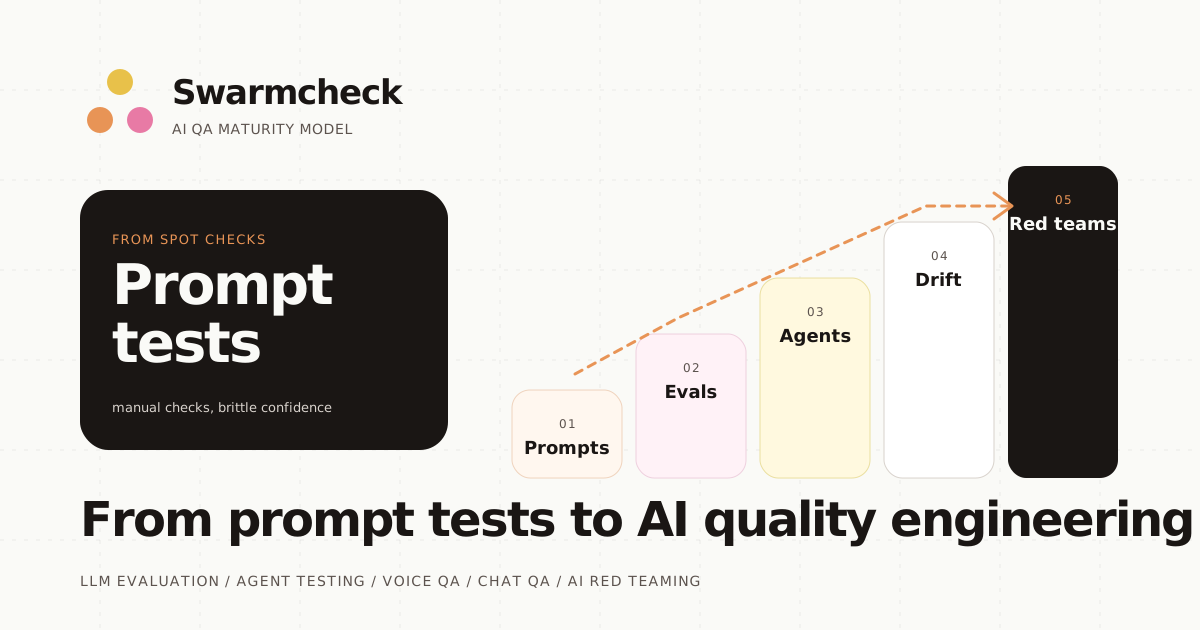
The five levels of AI QA maturity
| Level | What testing looks like | Release risk |
|---|---|---|
| 1. Prompt spot checks | Engineers manually try a few prompts before release. | High. Regression, hallucination, and policy failures are easy to miss. |
| 2. Golden datasets | The team runs prompt testing and LLM evaluation against known cases. | Medium. Prompt regression is visible, but production drift is limited. |
| 3. Agent and channel QA | AI agent testing, chat agent QA, and voice agent QA measure real workflows. | Lower. Tool use, context retention, and handoff failures are measured. |
| 4. Observability and drift | Production monitoring tracks quality, latency, alerts, and regression delta. | Lower still. The team can see degradation after launch. |
| 5. Quality system with red teaming | Semantic evals, swarm testing, security testing for AI, and release readiness are centralised. | Managed. The organisation can ship faster because risk is measured. |
The goal is not to reach level five for every experiment. The goal is to match quality investment to user risk. A private internal helper may need a lighter loop. A support agent that can quote policy, access customer records, or trigger refunds needs a stronger one.
Level 1 to 2: move from prompts to regression suites
The first maturity jump is from informal prompt testing to repeatable regression. Create golden datasets from real tickets, transcripts, search queries, tool traces, refusal examples, and known boundary cases. Then score outputs with calibrated rubrics, not string matching.
- For chat agent QA, track goal completion rate, hallucination rate, refusal accuracy, context retention, and tone consistency.
- For prompt testing, compare regression delta across prompt edits, model changes, retrieval changes, and policy updates.
- For grounding, check whether answers are supported by the provided context, not just whether they sound confident.
This is where LLM-as-judge scoring becomes useful, provided the rubric is specific and calibrated with human review. As discussed in the maturity table above, this level reduces obvious prompt regression but does not yet prove that the whole product workflow works. For the wider contrast, see Traditional QA is testing the wrong thing.
Level 3: test AI agents, chat agents, and voice agents in context
The next jump is contextual AI testing. A model answer may be acceptable in isolation and still fail inside the product. Swarmcheck AI treats this as a product-quality problem: Phase 1 starts with AI-driven QA automation, including auto-generation, self-healing, and browser automation. Phase 2 adds swarm testing, where AI agents test a product like real users.
For AI agent testing, useful metrics include tool correctness, step efficiency, plan adherence, loop detection, and workflow completion. For voice agent QA, measure WER, time to first response, mean opinion score, barge-in handling, accent robustness, and escalation quality. For chat agent QA, look at context retention across turns, refusal accuracy, hallucination rate, and whether the user actually completed the goal.
This is also where silent failures become visible. The checkout flow can pass, the API can return 200, and the AI can still choose the wrong plan, miss a constraint, leak context, or invent an answer. AI QA has to inspect the behaviour, not just the container around it.
Level 4 to 5: add observability, drift, and AI red teaming
Mature AI quality engineering does not stop at release. Production monitoring should track drift rate, regression delta, release readiness, alert volume, latency, and evaluation coverage. These platform-level metrics tell teams whether quality is stable enough to ship and observable enough to operate.
At the highest maturity level, AI red teaming becomes part of the release process. Security testing for AI should measure jailbreak success rate, prompt injection resistance, data leakage rate, unsafe tool use, and whether the system follows refusal policy under pressure. Red teaming is not a one-off audit. It is an adversarial regression suite that evolves as the product, model, and threat landscape change.
This is the point where Swarmcheck AI ties the phases together. Phases 3 and 4 layer in voice and chat QA. Phase 5 centralises AI quality, giving teams one place to evaluate, observe, and improve LLM applications. Phase 6 adds AI red teaming and adversarial security checks. For deeper evaluation design, read The art and science of evaluating AI agents.
How to use this model this week
- Pick one AI workflow where a confident wrong answer would damage trust.
- Write down the failure modes: hallucination, weak grounding, context loss, unsafe action, data leakage, latency, or jailbreak.
- Create a small golden dataset from real examples and boundary cases.
- Define a rubric that describes acceptable behaviour in plain language.
- Run the suite before release, then monitor drift and alert volume after release.
- Add adversarial cases whenever production, support, or security uncovers a new failure mode.
See how Swarmcheck brings AI-driven QA, semantic checks, evidence, and release confidence into one product.
Explore how Swarmcheck agents run product checks across releases, production, and critical user flows.
Read the practitioner guide to AI testing methodology, metrics, and quality signals.
A tactical checklist for prompt regression, agent behaviour, LLM evaluation, and AI red teaming.
Swarmcheck AI is founded by Naveen Bhati, who is building around a practical truth: AI-native products need quality systems that test judgement, not only journeys. You can connect with Naveen Bhati on LinkedIn.
If your team is moving from ad hoc AI testing to AI quality engineering, start by measuring the workflow you trust least. Then book a demo with Swarmcheck AI or read the AI QA white paper to see how a full quality system can support release confidence.
Point an agent at your worst flow.
The fastest way to find out if Swarmcheck fits your team is to run it against the flow you trust the least.