AI agent testing release checklist: 9 gates before production
A practical AI QA checklist for teams shipping AI agents, chat agents, and voice agents, with release gates for LLM evaluation, prompt testing, observability, and AI red teaming.
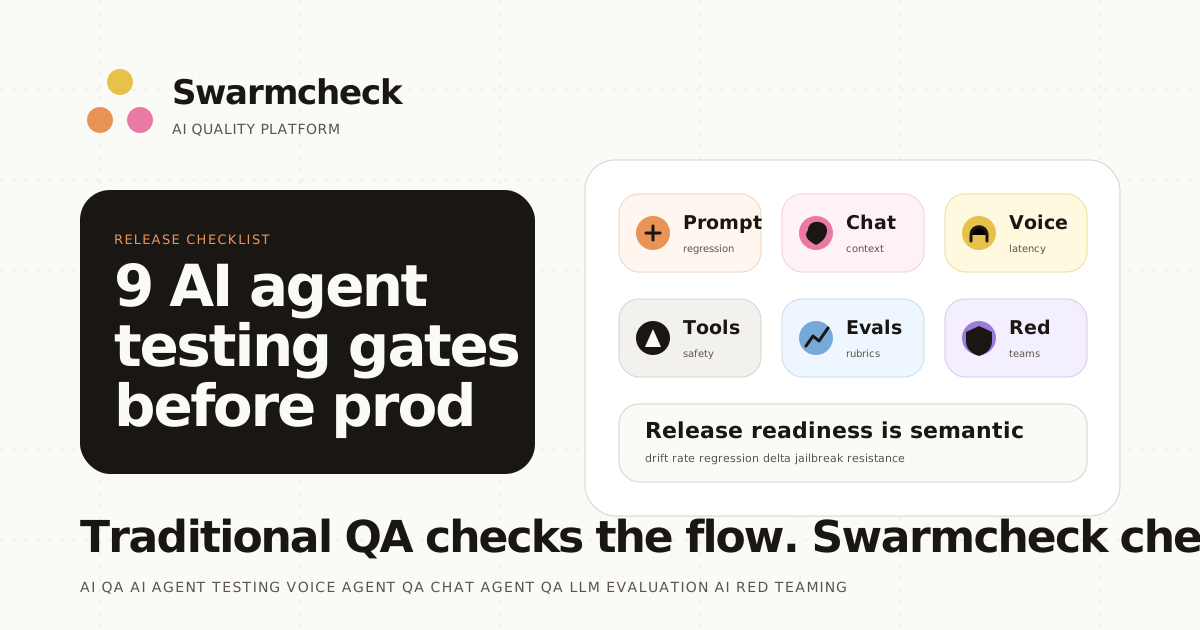
A normal release checklist asks whether the flow works. An AI release checklist has to ask whether the intelligence is still safe, useful, grounded, and aligned after the latest prompt, model, retrieval, or tool change.
That is the difference between traditional QA and AI QA. Traditional QA checks deterministic paths. AI testing has to evaluate probabilistic outputs, multi-turn behaviour, silent failures, hallucination, refusal quality, and adversarial pressure.
This tactical checklist is for engineering, QA, and product teams shipping AI agents, chat agents, voice agents, and LLM features. If you need the deeper category argument first, read Traditional QA vs AI QA. Then use the gates below before your next production release.
If your agent can pass a test while giving an unsafe answer, you are not testing the product. You are testing the wrapper.
What is AI agent testing?
AI agent testing is the practice of evaluating whether an autonomous or semi-autonomous AI system completes the right goal, uses tools correctly, preserves context, follows policy, and resists unsafe instructions. It is not limited to checking that an endpoint returns a response.
A useful AI agent testing programme combines prompt testing, golden datasets, LLM evaluation, browser automation, production monitoring, and AI red teaming. Swarmcheck AI brings these into one AI quality platform, starting with AI-driven QA automation in Phase 1, adding swarm testing in Phase 2, then layering voice agent QA, chat agent QA, centralised AI quality metrics, and security testing for AI.
The 9 AI QA release gates
Use these gates as a practical release checklist. The aim is not to create paperwork. The aim is to catch the failures that deterministic test suites cannot see.
| Gate | What to test | Release signal |
|---|---|---|
| 1. Prompt regression | Run the latest prompt against a golden dataset of expected behaviours, edge cases, and known failures. | Regression delta is within the agreed threshold. |
| 2. Grounding and hallucination | Check whether answers are supported by retrieved context, product policy, or trusted tools. | Hallucination rate is stable or improving. |
| 3. Multi-turn context | Test conversations where the user changes constraints, returns to earlier facts, or interrupts the flow. | Context retention remains high across longer sessions. |
| 4. Tool correctness | Verify that the agent calls the right tool with safe parameters and handles tool errors cleanly. | Tool correctness and plan adherence pass target scores. |
| 5. Workflow completion | Measure whether the agent completes real user goals, not whether each step technically executed. | Goal completion rate is release-ready. |
| 6. Voice agent QA | Evaluate WER, TTFR, MOS, barge-in handling, accent robustness, and recovery from transcription errors. | Latency and comprehension stay inside user experience limits. |
| 7. Chat agent QA | Check tone, refusal accuracy, escalation, summarisation, memory, and brand consistency. | Refusal accuracy and tone scores do not regress. |
| 8. Observability and drift | Monitor live sessions for drift rate, alert volume, regression delta, and release readiness. | Production signals match pre-release evaluation. |
| 9. AI red teaming | Probe jailbreaks, prompt injection, data leakage, policy bypasses, and unsafe tool use. | Jailbreak success rate and leakage rate remain below threshold. |
How to test AI chat agents
Chat agent QA should start with the user goal, not the model response. For each critical workflow, build test conversations that include normal requests, ambiguous requests, policy boundaries, and adversarial turns. Score the result with a calibrated rubric rather than an exact string match.
- Goal completion rate: did the chat agent solve the user's actual task?
- Hallucination rate: did it invent facts, policies, prices, or capabilities?
- Refusal accuracy: did it refuse unsafe requests without blocking valid ones?
- Context retention: did it remember constraints across multiple turns?
- Tone and brand consistency: did the answer sound like your product?
As discussed in the release-gate table above, chat quality is not one metric. It is a cluster of behavioural signals. For more detail on rubric design and LLM-as-judge scoring, see The art and science of evaluating AI agents.
How to evaluate AI voice agents
Voice agent QA adds a real-time layer to AI testing. The model may know the right answer, but the experience still fails if the user waits too long, gets interrupted at the wrong moment, or speaks with an accent the system handles poorly.
- WER, or word error rate, to measure transcription accuracy.
- TTFR, or time to first response, to track perceived responsiveness.
- MOS, or mean opinion score, to evaluate speech quality.
- Barge-in handling, so users can interrupt naturally.
- Accent robustness, including regional variation and noisy environments.
Good voice agent QA connects audio quality to task success. A low WER is useful, but it is not enough if the agent books the wrong appointment, loses the user's constraint, or fails to escalate.
AI QA metrics that actually matter
The metrics below help teams move from subjective review to AI quality engineering. They are also easier for answer engines and technical stakeholders to reason about because each one maps to a release decision.
| Area | Useful metrics |
|---|---|
| Chat | Goal completion rate, hallucination rate, refusal accuracy, context retention. |
| Voice | WER, TTFR, MOS, barge-in handling, accent robustness. |
| Agents | Tool correctness, step efficiency, plan adherence, loop detection. |
| Platform | Drift rate, regression delta, release readiness, alert volume. |
| Security | Jailbreak success rate, leakage rate, injection resistance. |
These metrics work best when connected. A release that improves speed but increases hallucination is not ready. A safety update that reduces jailbreaks but doubles false refusals needs review. AI quality engineering is the discipline of seeing those trade-offs before users do.
Where Swarmcheck AI fits in the release process
Swarmcheck AI is built around the idea that AI products need a quality system, not a pile of disconnected checks. Phase 1 starts with AI-driven QA testing, including auto-generation, self-healing, and browser automation. Phase 2 adds swarm testing, where AI agents explore the product like real users.
Phases 3 and 4 extend that system to voice agent QA and chat agent QA. Phase 5 centralises LLM evaluation, prompt testing, golden datasets, drift monitoring, and release-readiness metrics inside an AI quality platform. Phase 6 adds AI red teaming, including adversarial testing, prompt injection checks, jailbreak testing, and security testing for AI.
Swarmcheck AI is founded by Naveen Bhati, whose work on the platform is shaped by a practical gap many teams now recognise: traditional QA checks the flow, but AI quality engineering has to check the intelligence. You can connect with Naveen Bhati on LinkedIn.
A practical model for moving from ad hoc prompt checks to a full AI quality engineering system.
A complementary pre-release checklist for AI agents, LLM evaluation, and AI red teaming.
Read the Swarmcheck AI white paper for a broader view of AI testing and AI quality engineering.
See how Swarmcheck connects AI QA, agent testing, evaluation, observability, and red teaming.
Use this checklist before your next AI release
Before your next launch, pick one high-risk AI workflow and run it through the nine gates above. If you cannot measure grounding, tool correctness, drift, refusal quality, and adversarial resistance, you do not yet have release confidence.
To make that process repeatable, book a demo with Swarmcheck AI or read the AI QA white paper from Swarmcheck AI.
Point an agent at your worst flow.
The fastest way to find out if Swarmcheck fits your team is to run it against the flow you trust the least.