The art and science of evaluating AI agents
Our ability to measure AI agents has fallen behind our ability to build them. Here is a framework for what great evaluation actually looks like — and where the field needs to go next.
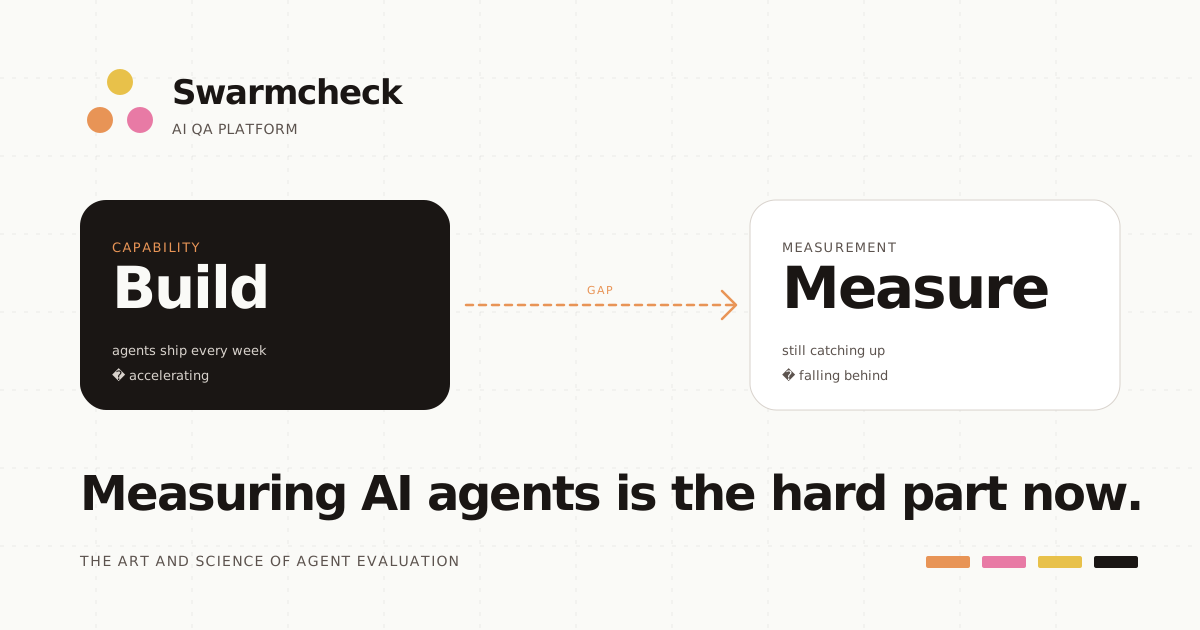
There is a strange asymmetry at the heart of AI agent deployment today. The teams we talk to can build agents that book flights, write code, answer support tickets, and run compliance checks. What they struggle with is something quieter: knowing whether those agents are actually doing it right — reliably, safely, under real conditions.
The capabilities have moved faster than the infrastructure for trusting them. Engineering leaders who are excited about agents in demos become cautious when the conversation turns to high-stakes deployment — finance, healthcare, legal, customer operations. Not because the models are bad. Because the measurement is missing.
Building agents has gotten fast. Trusting what they produce is where the real work is.
This is the problem we are most interested in at Swarmcheck. After building verification infrastructure for production AI agents and working with teams across many industries, we have developed a clear view of what separates evaluation that works from evaluation that just looks like it does. It is partly science — rigorous, learnable, replicable. And it is partly art — judgment calls about what to measure and why. This post covers both. For the broader context on why verification is structurally hard, see the verification gap.
The gap is structural
The problem with agent evaluation is not that teams are lazy about it. It is that the standard toolkit is not built for the job. Classic test coverage works for deterministic systems: the same input should produce the same output. When an agent is in the loop, that contract breaks. The same input can produce a range of outputs — some correct, some close, some confidently wrong. An exact-match assertion does not tell you whether the answer was safe, grounded, policy-compliant, or useful. It only tells you whether the string matched.
We see the gap in the teams that ship agents and then discover failures through support tickets rather than quality systems. We see it in the organizations deploying faster than they can verify. The enterprise hesitation around autonomous agents is not unfounded — it is a rational response to a real measurement problem. The field has prioritized making agents more capable over making them more verifiable. That imbalance is now the constraint.
Start with real task quality
The individual tasks in an eval set need to represent real-world complexity. That sounds obvious, but it is regularly violated. Synthetic tasks built by the team that built the agent tend to reflect the assumptions baked into the agent. They test the cases the team thought of — not the cases the world actually produces.
Useful eval tasks come from real usage: actual queries, real edge cases, genuine failure modes from production. They should be reviewed by people who did not design the system being tested, because only an outside perspective can catch the failure modes the original team is blind to. And they should be verifiable — there should be a clear, defensible answer for whether the agent's output was correct.
The adversarial quality control step is underrated. Not only do tasks need to be well-posed — they need to be tractable for an independent reviewer to evaluate. If your eval tasks require deep insider context to score correctly, they are not measuring what you think they are measuring.
Build coverage around failure modes, not frequency
A good eval suite is not a random sample of traffic. It is an intentional map of the failure space. That means defining what the important failure modes are — including the ones that are rare in volume but catastrophic in consequence — and making sure the eval set covers them proportionally to their importance, not to their frequency.
The classic mistake is building an eval set from traffic logs and ending up with something that is 90% happy-path completions. Real quality lives in the edge: the user who asks about a topic the system should refuse, the input designed to confuse the retrieval layer, the sequential interaction that exposes context management flaws. Think of safety-critical engineering — the rare failure mode that matters most is the one you have to design explicitly to cover.
- Define a taxonomy of your failure modes before sampling. What are the five to ten categories of failure that would cost the most?
- Include adversarial inputs, not just difficult honest ones. The failure modes users discover intentionally are often the most damaging.
- Weight edge cases above their frequency. A one-in-a-thousand event that causes data loss deserves more eval coverage than a hundred common happy paths.
Keep headroom in your benchmarks
An eval set that every model passes is not measuring anything useful. The best eval sets retain headroom: they should still separate good agents from great ones, even as models improve. Eval suites that saturate too quickly stop steering the quality effort and start just being checkbox exercises.
The production version of this principle: does your eval suite catch the actual failures your agents produce today, or does it only catch obvious mistakes they stopped making six months ago? A stale eval set is worse than no eval set, because it creates false confidence. Audit your coverage regularly against real failures. If the suite would have missed the last three production incidents, it is no longer measuring the right things.
Measure what actually matters, not just accuracy
Accuracy is the starting point, not the destination. Production agent quality includes cost, latency, reasoning trace quality, tool use correctness, policy adherence, and escalation behavior. An agent that completes a task while violating a constraint is not a success — it is a liability.
An agent that gets the right outcome but violates a policy constraint in the process has still failed. Your eval methodology has to capture that.
Eval methodology should measure the axes that actually matter for the specific deployment context. A customer support agent is evaluated differently from a code review agent, which is evaluated differently from a financial document processor. Copy-pasting another team's eval rubric is a shortcut that usually produces measurement that is technically valid and practically useless.
| Agent type | Accuracy is not enough — also measure | Critical failure to catch |
|---|---|---|
| Customer support agent | Policy adherence, refusal accuracy, escalation quality, hallucination rate | Agent invents a policy that does not exist, exposing the company to liability |
| Code review agent | False negative rate, reasoning quality, suggestion safety | Agent approves a security flaw with high confidence |
| Workflow automation agent | Tool correctness, step efficiency, loop detection, rollback behavior | Agent calls the right tool with the wrong parameters, silently corrupting data |
| Research or retrieval agent | Grounding rate, source fidelity, uncertainty communication | Agent confidently cites a source that says the opposite of the stated conclusion |
Have a thesis — know what you are actually measuring
Getting the science right produces reliable measurement. What makes measurement actually useful is something harder to teach: a thesis.
The best evaluation systems are built around a specific bet: here is where I think the important failure mode is, and here is the capability I am going to measure against it. This is not just a research disposition. It is practical discipline for production teams. When your eval suite is built around a thesis, a coherent failure teaches you something. When you build one without a thesis, you get noise that is hard to act on.
Our thesis at Swarmcheck is that the most important things to measure in production agents are goal completion, policy adherence, tool correctness, and adversarial robustness. Everything we build in our eval infrastructure traces back to those four axes. That thesis also shapes where we invest next: when production failures cluster around one axis, that is where the next improvement goes.
For teams building layered eval infrastructure from scratch, the practical version of a thesis is: start with your worst flow. As we described in evals for QA agents without losing your mind, the eval set that grows from real failures is more valuable than any synthetic eval set. Every production incident that becomes an eval the same day is compounding measurement intelligence over time.
Make evals easy to run, or they will not get run
This is the most underrated factor in whether evaluation actually happens. If running your eval suite is painful — slow, expensive, poorly documented, or hard to extend — teams find reasons not to run it. The quality of evaluation infrastructure is partly a technical problem and partly a user experience problem.
The hardest eval systems to trust are the ones nobody is running consistently. An eval suite that requires significant setup to operate will not be run before every release. It will be run when someone remembers to run it, which is usually after something goes wrong. Whatever you build for measuring agent quality, build it to be easy to extend, easy to run, and easy to interpret. The feedback loop only works if the loop actually closes.
- Lightweight checks should run on every pull request — not nightly, not on release candidates, on every PR. If the cost is prohibitive, sample; do not skip.
- Every result needs an interpretable output. A pass or fail without a trace, a replay, or a reasoning record is not evidence — it is a claim. Evidence is what you can act on.
- Treat the eval set like product code. It needs maintenance, versioning, and owner accountability. An unmaintained eval set drifts out of sync with the real system.
Three dimensions where evaluation coverage is thin
There are areas where agent evaluation is systematically underdeveloped — not exotic edge cases, but the dimensions where agents fail most visibly in production.
- Environment complexity: Most eval suites test agents in clean, controlled conditions. Real production environments are not clean. Real deployments have org-specific policies, parallel contributors, distributed tooling, noisy inputs, and accumulated context that no static fixture can replicate. The gap between what evals test and what real environments look like is exactly where agents fail most often. A coding agent's real operating environment includes flaky CI, undocumented tribal knowledge, and human reviewers with preferences that live only in their heads.
- Autonomy horizon: Short-horizon tasks — do this one thing right now — are reasonably well-covered. Long-horizon tasks — operate for many steps across time in a changing environment — are not. Context management degrades. Plans go stale. Constraints set early in a workflow stop being honored late in it. Requirements change mid-execution. These are the failure modes that matter most for autonomous agents operating in real organizations, and the ones most eval suites miss entirely.
- Output complexity: Plain text answers are well-covered. Complex artifacts, tool call sequences, nuanced policy adherence signals, and uncertainty communication are not. An agent that confidently produces a wrong answer is more dangerous than one that says it does not know. Building measurement that rewards calibrated uncertainty and penalizes false confidence is a genuinely hard open problem that most eval frameworks have barely started on.
Where Swarmcheck fits in this picture
Swarmcheck is the continuous verification layer for production AI agents. Our checks are written in plain English against goals and behaviors — not against implementations or selectors. That means they work when the underlying agent changes, when the environment changes, and when the task changes, because they are always testing the thing that actually matters. For teams building agentic systems, the same principles apply in the context of self-evolving AI agents, where the architecture itself changes continuously and static test suites cannot keep up.
We run layered evals across every deployment: lightweight checks on every pull request, behavior evals on every model change, end-to-end goal completion checks against real flows. Each layer has a different cost, a different question, and a different cadence. We monitor in production, not just at release time — because agents that work at launch degrade as the world changes. And we treat every production failure as an eval: false negatives become checks the same day, so the system gets smarter from real failures rather than synthetic ones.
The eval set is the product. The agent is the thing it produces.
Why AI builds faster than you can verify, and what closing that gap actually requires.
A pragmatic guide to evaluating autonomous testers at scale, with the tradeoffs we made along the way.
How dynamic agent systems change the way teams think about verification, evals, and quality coverage.
See how Swarmcheck brings autonomous QA, semantic checks, evidence, and release confidence into one product.
Swarmcheck AI is founded by Naveen Bhati, who is building around a clear gap: the field has invested heavily in making agents more capable and almost nothing in making them more verifiable. You can connect with Naveen Bhati on LinkedIn.
If your team is shipping AI agents and has no clear answer for how you know whether they are getting it right — that is the gap we are building to close. Talk to Swarmcheck about building your evaluation layer.
Point an agent at your worst flow.
The fastest way to find out if Swarmcheck fits your team is to run it against the flow you trust the least.