8 ways self-evolving AI agents are rewriting the QA playbook
AI systems that construct, improve, and reuse their own subagents are moving from research to engineering practice. Here is what that shift means for the teams responsible for verifying them.
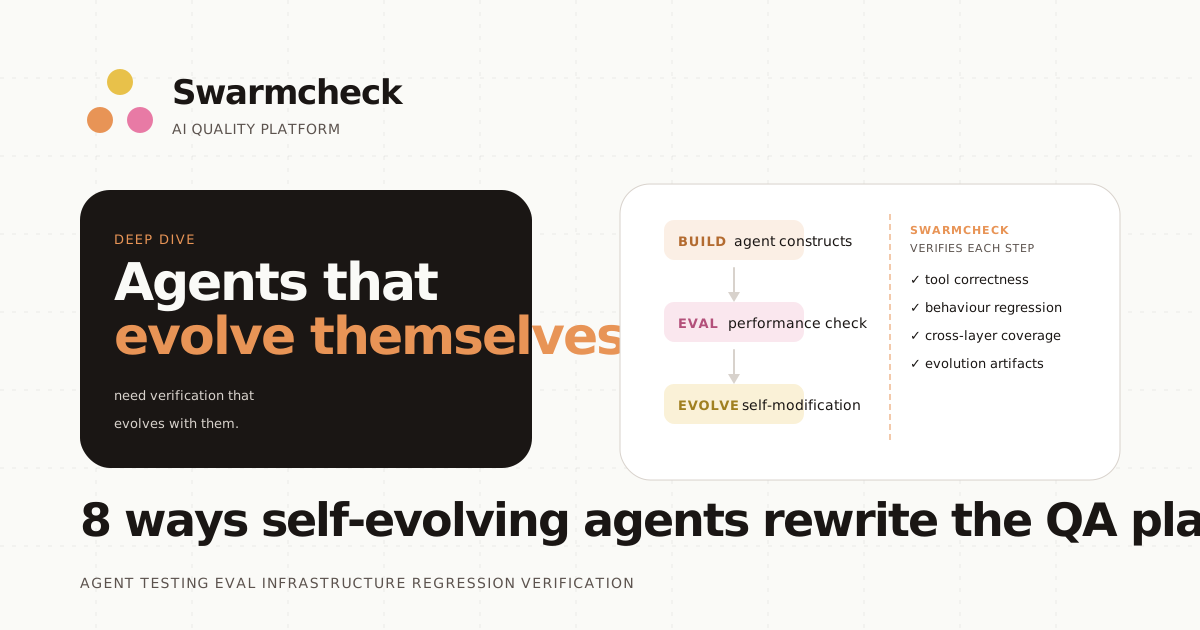
The architecture of AI systems is changing. Where agent pipelines used to be designed upfront — fixed roles, fixed workflows, fixed interactions — a new model is emerging: systems where a master agent constructs specialist subagents on demand, evaluates their performance, and refines them through closed feedback loops without human intervention. The workforce is no longer designed in advance. It designs itself.
For engineering teams building with these systems, this is an exciting shift. For QA teams responsible for verifying them, it is a structural challenge. Every assumption that underpins a traditional test suite — stable inputs, predictable outputs, fixed agent roles — breaks down when the system is continuously modifying itself.
The hardest thing to test is something that was not the same yesterday as it is today.
Here are eight ways this shift in AI architecture is rewriting the rules of quality assurance — and what each one means for teams that want to keep up.
1. When the system designs its own workforce, your QA must be just as dynamic
Traditional multi-agent systems are designed upfront. You map out the agents, define their roles, and write tests against that fixed architecture. Self-evolving systems abandon that contract. A master agent analyzes each incoming task and constructs the specialist it needs from scratch. The workforce is different on each run.
Hardcoded test scripts tied to specific agents, specific selectors, or specific call sequences do not survive this model. QA needs to move to intent-based verification: does the system achieve the goal correctly, safely, and efficiently — regardless of which subagents it assembled to get there.
Swarmcheck's plain-English checks are written against outcomes, not implementation paths. When an agent assembles a different specialist to complete a task, the check still runs. The assertion is the goal, not the route. That is the same principle that makes intent-based QA agents outlast scripted suites in fast-moving codebases.
2. Self-improvement is a regression risk you cannot see coming
In a self-evolving system, agents do not just run tasks. After each task, the system retrieves the subagent that handled it, assesses its performance, analyzes what went wrong, and autonomously modifies the agent before the next run. There is no human in that loop and no change log that looks like a commit.
This creates a class of regression that traditional CI cannot catch. The code has not changed. The prompt has not changed. The model has not changed. What has changed is the agent's own encoded behaviour — and it changed in production, silently, between two test runs.
- Behavioural regressions appear without a triggering diff — there is no PR to annotate.
- The improvement loop is optimizing for internal performance signals, which may not align with your user-facing quality standards.
- Evals written against version N of a subagent may not catch the failure mode introduced in version N+1.
The answer is continuous verification: production heartbeats that run after every evolution cycle, not just after deploys. That is exactly the use case described in the verification gap — the system that produces the output cannot also reliably judge it.
3. Persistent agent libraries need persistent test coverage
One of the most compelling features of self-evolving agent systems is the persistent library: agents that perform well get stored and reused across future tasks. The library accumulates validated, task-specific expertise over time. The more the system runs, the more capable it becomes.
But a library of agents without a corresponding library of quality checks is a liability accumulator. Every subagent added to the library is a reused unit of potential failure. If a subagent carries a subtle behavioural flaw — a tool it calls incorrectly under edge conditions, a scope boundary it sometimes violates — that flaw ships every time the subagent is reused.
The principle here mirrors what works in code: treat the test suite as a first-class artifact alongside the thing being tested. When a subagent is added to the library, a corresponding Swarmcheck check set should be added too — covering tool correctness, goal completion, boundary behaviour, and adversarial inputs.
4. Portability without verification is just risk portability
Self-evolving agent frameworks enable something genuinely new: subagents built and validated in one environment can be exported and deployed in another. A subagent developed inside one pipeline can be integrated into a different system, shared across teams, or used standalone.
The word to focus on is validated. A subagent validated against one workload in one environment is not automatically valid for a different workload in a different context. When you export an agent, you are exporting its behaviour envelope — including its failure modes.
- Context shifts: a subagent optimized for internal tooling may have unsafe defaults when exposed to user-generated inputs.
- Tool availability: external frameworks may surface different tools or the same tools with different permissions.
- Boundary assumptions: a subagent that correctly refuses out-of-scope requests in one deployment may not in another, if the system prompt changes.
Portable agents need portable verification. The same check sets that validated a subagent in its origin environment should run against it in the destination environment before any traffic flows through it.
5. The skill hierarchy demands a layered testing strategy
Modern agentic systems are structured in layers. At the top, meta skills handle high-level reasoning and orchestration — deciding what needs to happen. In the middle, tool skills execute specific integrations and API calls. At the subagent level, encapsulated specialist agents handle discrete task types.
Each layer fails in different ways, and each layer needs a different testing strategy.
| Skill layer | What can go wrong | How to test it |
|---|---|---|
| Meta skills (orchestration) | Wrong subagent selected, task misclassified, plan abandoned mid-way. | End-to-end goal completion checks across varied task types. |
| Tool skills (integrations) | Wrong tool called, unsafe parameters passed, infinite retry loop. | Tool correctness checks, parameter validation, loop detection. |
| Subagent skills (specialists) | Scope boundary violations, hallucinated outputs, context drift. | Semantic checks, adversarial inputs, multi-turn behaviour evals. |
This maps directly to the layered eval approach covered in evals for QA agents: unit evals on the perception layer, behaviour evals on individual steps, and end-to-end evals on real flows. The skill hierarchy gives you the right mental model for which layer to target.
6. Evaluation has moved from afterthought to the hardest engineering problem
In traditional multi-agent systems, the hard work happens at design time. You spend weeks mapping out agent roles, interactions, and failure modes. The architecture is finalized before a single task runs.
Self-evolving systems invert this. The system handles much of its own design. What you cannot offload is evaluation: defining what good performance looks like, and making sure the self-evolution loop is improving in the direction you actually want.
The bottleneck has moved from designing agents to evaluating them. That is a different engineering problem — and arguably a better one.
This is exactly the problem Swarmcheck is built for. Evaluation should not live in a notebook nobody checks. It should be part of the quality system: golden datasets in CI, LLM-as-judge scoring with calibrated rubrics, production monitoring, and drift detection after launch. The more autonomously an agent system improves itself, the more consequential your evaluation infrastructure becomes.
For teams building this evaluation foundation, the AI QA checklist covers the key gates: prompt regression, multi-turn behaviour, tool correctness, semantic evals, and adversarial coverage.
7. Shared agents without shared quality standards create shared failure modes
One of the more underappreciated implications of self-evolving agent systems is cross-team reuse. Subagents built and validated in one environment can be transferred to and reused in another. This opens the door to something closer to an ecosystem: teams sharing and building on each other's validated subagents rather than rebuilding equivalent capability from scratch.
The word validated is doing a lot of work in that sentence. When your team adopts a subagent built by another team, you are also inheriting its failure modes — unless there is a shared quality standard that defines what validated actually means.
- What rubric was used to evaluate it? Is that rubric aligned with your product's quality bar?
- What adversarial inputs was it tested against? Does your threat model match theirs?
- What version was validated? Has the self-evolution loop modified it since?
- Under what context assumptions is it safe? Do those assumptions hold in your system?
Teams that want to participate in an ecosystem of shared agents need to invest in portable, inspectable quality standards — not just functional validation, but semantic, safety, and boundary coverage that travels with the agent.
8. A static test suite cannot verify a dynamic architecture
Taken together, what self-evolving agent systems describe is a world where AI agents behave less like fixed functions and more like living components: they construct themselves, improve themselves, and accumulate over time. The mental model of a fixed, hand-designed agent pipeline is already starting to feel dated.
A static test suite — fixed selectors, hardcoded assertions, scripts tied to specific agent versions — cannot verify this architecture. It can only tell you whether a specific snapshot of the system, at a specific moment, matched a specific expectation. That is not verification. It is archaeology.
What self-evolving architectures require is continuous, intent-based, semantically-aware verification that runs against the system as it actually behaves today — not as it was designed to behave six months ago. Swarmcheck checks are written in plain English against outcomes. They survive redesigns, agent modifications, and subagent substitutions, because they are testing the goal, not the implementation.
Where Swarmcheck fits in the self-evolving agent stack
Every shift described above points at the same structural need: an external, independent verification layer that runs continuously, adapts to architectural change, and produces artifacts teams can actually inspect.
Swarmcheck provides that layer. The unit of work is a plain-English check — a description of a goal, a behaviour, a constraint. The agent runs it against a real browser or real system, observes the result the way a user would, and returns a verdict with a full replay and reasoning trace. Because checks are written against outcomes, they work whether the underlying agent assembles one subagent or ten to complete the task.
- Continuous production heartbeats that catch regressions introduced by self-evolution cycles, not just by code deploys.
- Layered eval infrastructure covering orchestration, tool correctness, and specialist subagent behaviour independently.
- Adversarial coverage for prompt injection, scope bypass, unsafe tool use, and boundary violations — checks that static suites cannot run.
- Portable check sets that travel with subagents across environments, giving cross-team reuse a quality foundation.
The question for engineering teams is not whether self-evolving architectures are coming. They are here. The question is whether your quality infrastructure can keep pace with a system that is continuously changing itself.
Why AI builds faster than you can verify, and what closing that gap actually requires.
A practical checklist for teams testing chat agents, voice agents, LLM workflows, and agentic behaviour before release.
How to test the tester with layered evals, real failures, and cost discipline.
See how Swarmcheck brings autonomous QA, semantic checks, evidence, and release confidence into one product.
If you are building with self-evolving or agentic systems, start by mapping your verification gaps: which agent layers have no external coverage, which evolution cycles run without a quality check, and which shared subagents have been adopted without independent validation. Then talk to Swarmcheck about closing them.
Point an agent at your worst flow.
The fastest way to find out if Swarmcheck fits your team is to run it against the flow you trust the least.