7 AI QA checks to run before shipping an AI agent
A practical AI QA checklist for teams testing chat agents, voice agents, LLM workflows, prompt changes, and agentic product behaviour before release.
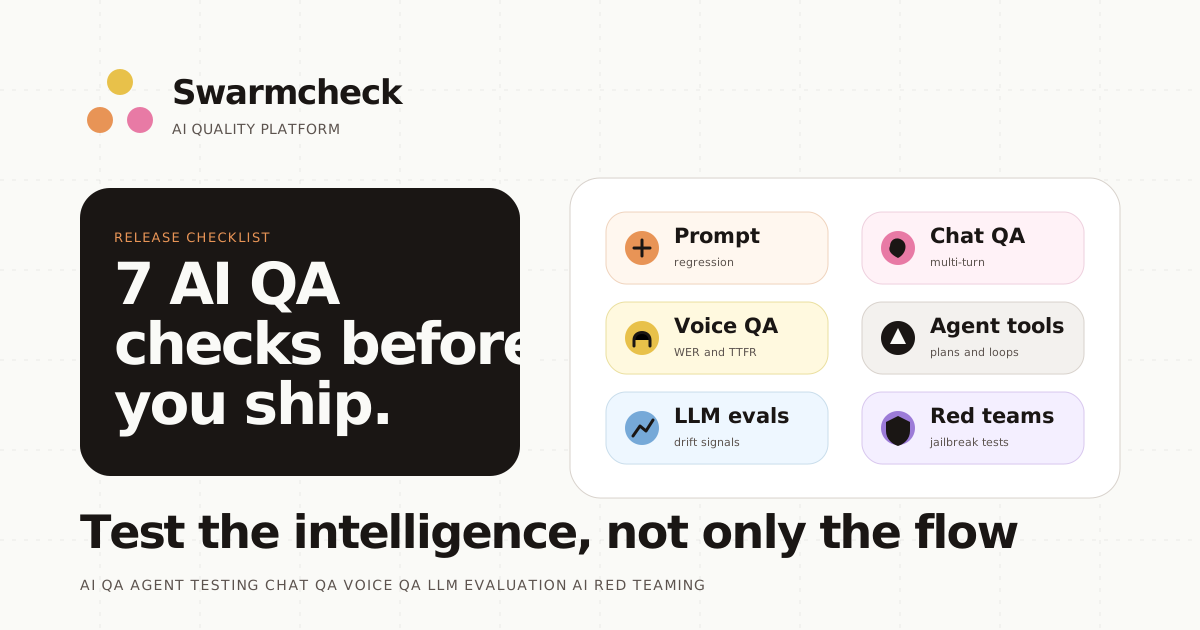
The most dangerous AI release is not the one that crashes. It is the one that sounds confident while doing the wrong thing. A chat agent can hallucinate a policy, a voice agent can misunderstand an accent, and an AI agent can call the wrong tool while every traditional health check stays green.
That is why AI QA needs a different release checklist. Traditional QA checks the flow. Swarmcheck AI checks the intelligence. If your product uses prompts, models, retrieval, tools, memory, or conversational interfaces, your AI testing has to cover semantic behaviour, not just page state. For the wider foundation, read our Beginner's guide to AI QA.
A release is not AI-ready because the interface works. It is AI-ready when the behaviour is useful, grounded, observable, and hard to break.
1. Prompt regression testing
Prompt testing is the first gate because small wording changes can create large behavioural changes. A safer prompt can over-refuse. A more helpful prompt can leak policy. A model upgrade can shift tone, length, citation style, or boundary handling without breaking an API contract.
- Run a golden dataset of realistic user requests before every prompt, model, retrieval, or tool change.
- Score for grounding, refusal accuracy, tone, brand consistency, and workflow completion.
- Track regression delta so teams can see whether a change improved quality or just moved the failure elsewhere.
This is where exact-match assertions usually fail. For AI quality engineering, the question is not whether the model returned the same sentence. The question is whether it met the rubric.
2. Chat agent QA for multi-turn behaviour
How to test AI chat agents: test the conversation, not the message. Many chat failures appear only after three or four turns, when the agent loses context, forgets a constraint, repeats itself, or starts answering outside policy.
| Chat agent risk | AI QA check | Useful metric |
|---|---|---|
| Hallucinated policy | Ask about refunds, pricing, eligibility, or legal terms using realistic phrasing. | Hallucination rate |
| Poor refusal behaviour | Mix legitimate requests with unsafe or out-of-scope requests. | Refusal accuracy |
| Lost context | Add constraints early, then ask the agent to apply them later. | Context retention |
| Unfinished task | Give the agent a goal that requires clarification, retrieval, and handoff. | Goal completion rate |
As discussed in the prompt regression section above, use rubrics rather than brittle strings. A good chat agent QA suite should include normal users, confused users, impatient users, and adversarial users.
3. Voice agent QA for real call conditions
Voice agent QA adds speech, timing, and interruption risk. A voice agent can have a strong LLM response and still fail because it starts too slowly, misses a number, handles barge-in badly, or sounds unnatural enough to make users abandon the call.
- Measure WER for transcription quality across accents, noisy backgrounds, and domain vocabulary.
- Track TTFR, because a correct answer that starts too late still damages the experience.
- Use MOS or a similar quality score to monitor naturalness and audio experience.
- Test barge-in handling, handoff, confirmation, and recovery from misunderstood intent.
Voice QA should combine automated scoring with scenario replay. The transcript, audio, timing trace, and final outcome all matter.
4. AI agent testing for tools, plans, and loops
AI agent testing is different from chatbot testing because the agent can take actions. It may search, update records, trigger workflows, send messages, or use internal tools. The quality bar is therefore higher. Our earlier article on agents versus scripts explains why real-app behaviour matters here.
- Tool correctness: did the agent choose the right tool and pass safe parameters?
- Step efficiency: did it complete the task without unnecessary loops or repeated calls?
- Plan adherence: did it follow the intended workflow when the user changed direction?
- Loop detection: did it stop, escalate, or ask for help when progress stalled?
For agentic systems, silent failures are especially costly. The UI can look fine while the agent updates the wrong object. Swarm testing helps by sending AI agents through the product like real users, across many paths and edge cases.
5. LLM evaluation, observability, and drift monitoring
LLM evaluation should not live in a notebook that nobody checks before release. It needs to become part of the quality system: golden datasets in CI, LLM-as-judge scoring with calibrated rubrics, production monitoring, and drift detection after launch.
| Layer | What to watch | Release question |
|---|---|---|
| Golden datasets | Known good and bad examples from real workflows. | Did this change regress important behaviour? |
| LLM-as-judge | Rubric scores for grounding, safety, usefulness, and tone. | Is the answer acceptable, not merely syntactically valid? |
| Production monitoring | Drift rate, alert volume, latency, and regression delta. | Is quality changing after users and data change? |
| Release readiness | Evaluation coverage, failed critical cases, and unresolved risks. | Are we confident enough to ship this AI feature? |
This is the bridge from test runs to AI quality engineering. If you are building your own evaluator, the Swarmcheck article on evals for QA agents is a useful companion.
6. AI red teaming and security testing for AI
AI red teaming tests how the system behaves when users try to break it. That includes jailbreaks, prompt injection, data leakage, unsafe tool use, policy bypass, and retrieval poisoning. This is not a niche security exercise. It is release hygiene for AI-native products.
- Measure jailbreak success rate across sensitive policies and high-risk workflows.
- Track leakage rate for system prompts, secrets, customer data, and internal policy.
- Test injection resistance using malicious user input and malicious retrieved content.
- Include adversarial tests in regression suites, not only in one-off security reviews.
7. Put the checks into one AI quality platform
The hard part is not naming the checks. The hard part is making them run together. Swarmcheck AI starts with AI-driven QA testing in Phase 1, adds swarm testing in Phase 2, layers in voice agent QA and chat agent QA in Phases 3 and 4, centralises AI quality in Phase 5, and adds AI red teaming in Phase 6. That is why we describe Swarmcheck as an AI quality platform, not only an automation tool.
See how Swarmcheck brings autonomous QA, semantic checks, evidence, and release confidence into one product.
Explore pre-merge checks, release regression, production monitoring, and mobile QA workflows.
A comparison of deterministic QA and AI QA for hallucinations, prompt injection, tool calls, and semantic failures.
Swarmcheck AI is founded by Naveen Bhati, whose work on the platform is grounded in a practical gap engineering teams now face: shipped AI needs quality systems that test intelligence, not only interfaces. You can connect with Naveen Bhati on LinkedIn.
If you are preparing an AI release, start with one high-risk workflow and run these seven checks against it. To see how Swarmcheck AI can help your team move from AI testing to AI quality engineering, book a demo with Swarmcheck AI or try the Swarmcheck AI beta.
Point an agent at your worst flow.
The fastest way to find out if Swarmcheck fits your team is to run it against the flow you trust the least.