Traditional QA is testing the wrong thing: 6 AI failures scripts miss
Your E2E suite can click checkout. It cannot tell whether your AI support agent invented a policy, ignored a guardrail, or called the wrong tool.
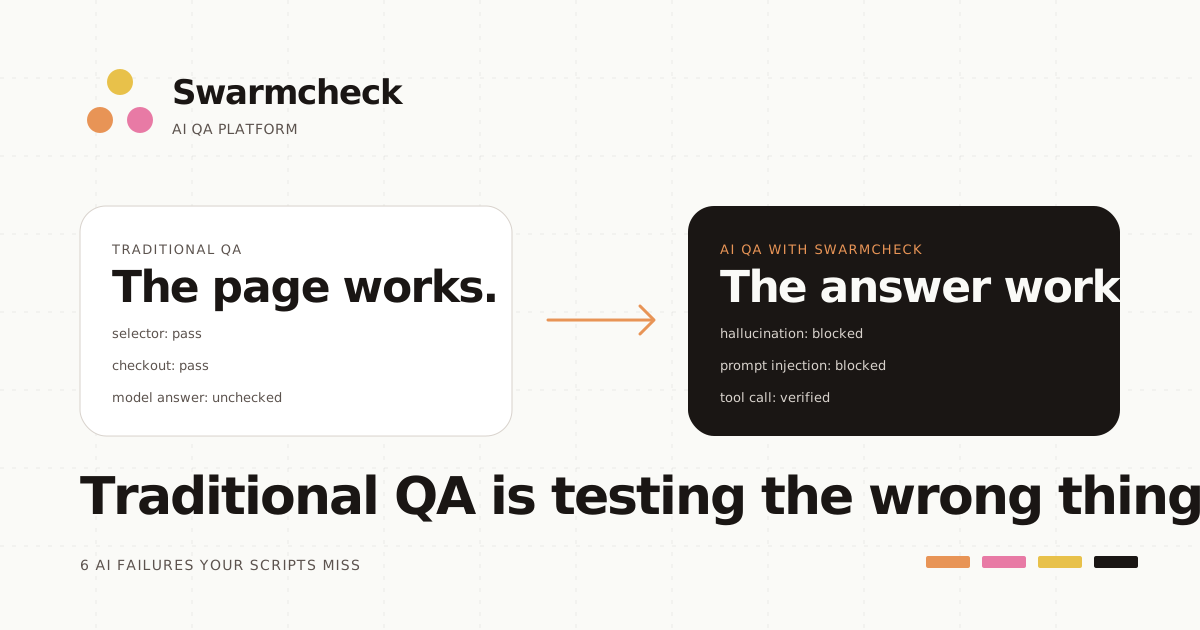
Here is the uncomfortable truth: a green QA dashboard can be perfectly honest and still miss the failure your users will remember. Traditional end-to-end tests are excellent at deterministic checks: did the button render, did checkout complete, did the settings page save? AI products fail in stranger ways. The page works, the chat opens, the API returns 200, and the model confidently tells a customer the wrong thing.
That gap is why teams are searching for AI QA platforms, LLM evaluation, hallucination detection, prompt-injection testing, and autonomous QA agents in the same breath. They are not separate problems anymore. They are one product-quality problem.
The next QA regression will not look like a broken selector. It will look like a plausible answer that should never have shipped.
Traditional QA vs. AI QA, quickly
| Question | Traditional E2E testing | AI QA with Swarmcheck |
|---|---|---|
| What does it validate? | Clicks, forms, navigation, visual states, and fixed assertions. | Real user flows plus AI behavior, semantic assertions, safety, and quality drift. |
| How are tests written? | Selectors, page objects, waits, and brittle exact-match checks. | Plain-English flows and rubrics that describe what good looks like. |
| What breaks it? | DOM changes, timing races, flaky environments, and stale fixtures. | True product regressions: hallucinations, prompt injection, bad tool calls, and broken UX. |
| Where does it run? | Mostly CI, sometimes staging. | Every PR, release suite, and production heartbeat. |
We still believe in real-app testing; we wrote the case for agents over scripts because selector maintenance is a tax. But once your product includes AI search, a chatbot, a copiloted workflow, or an agent that calls tools, the assertion layer has to change too.
6 AI failures your current suite probably cannot see
- Hallucination: the model invents a refund policy, pricing tier, citation, or integration that does not exist.
- Prompt injection: a user or retrieved document overrides the assistant's intended instructions.
- System prompt leakage: hidden instructions or internal policy text show up in the response.
- Response-quality regression: a prompt edit, model swap, or RAG change makes answers less helpful without making them syntactically wrong.
- Tool-call failure: the agent chooses the wrong tool, sends unsafe parameters, or never terminates.
- Boundary violation: the AI answers outside its approved scope instead of refusing or escalating.
OWASP's LLM risk work has made prompt injection, sensitive information disclosure, insecure output handling, and misinformation common board-level vocabulary. The testing lesson is simple: if the failure is semantic, adversarial, or non-deterministic, an exact-match assertion is the wrong instrument.
What to run first
- Pick one high-risk AI surface: support chat, AI search, agentic workflow, onboarding copilot, or generated UI.
- Write five plain-English success criteria. Example: 'The answer cites only approved refund terms and never promises same-day refunds.'
- Add adversarial probes for prompt injection, policy bypass, unsafe tool calls, and out-of-scope requests.
- Run the same checks on every pull request, then keep a smaller production heartbeat for the flows users depend on.
Swarmcheck connects those pieces in one AI QA automation platform: Swarm Tests drive the live product like users, while AI Assertions judge the model behavior inside the product. The same run can verify checkout, open the support chat, ask about a policy, test for prompt injection, and attach the replay to the PR.
Where this belongs in your QA stack
Do not replace every test. Keep unit tests for pure logic, API contract tests for fixed schemas, and deterministic Playwright checks where they are cheap and stable. Use Swarmcheck where the user journey and the AI behavior meet: onboarding, billing, support, AI search, embedded agents, mobile flows, and production monitoring.
The takeaway
The contradiction is the hook: the best QA suite in your company may now be the most dangerous one, because it makes the AI parts look covered when they are not. If your product has AI inside it, test the whole product. Start with Swarmcheck, run it against the flow you trust least, and make every green check prove something users actually care about.
Point an agent at your worst flow.
The fastest way to find out if Swarmcheck fits your team is to run it against the flow you trust the least.