Beginner's guide to AI quality engineering: how to test intelligence before release
AI quality engineering is the discipline of testing whether AI systems are useful, grounded, safe, observable, and ready to ship. Here is where to start.
The fastest way to misunderstand AI QA is to treat it as test automation with a model attached. It is not. AI quality engineering proves that an AI system behaves usefully, safely, consistently enough, and observably under real conditions.
Traditional QA checks the flow. Swarmcheck AI checks the intelligence. This beginner's guide explains what to test first, which metrics matter, and how to build a quality loop for chat agents, voice agents, AI agents, and LLM applications. For the wider comparison, read Traditional QA versus AI QA.
A passing UI test tells you the product can be used. AI QA tells you whether the product can be trusted.
What is AI quality engineering?
AI quality engineering is the practice of evaluating, testing, observing, and improving AI behaviour across the product lifecycle. It includes AI testing, prompt testing, LLM evaluation, AI agent testing, voice agent QA, chat agent QA, security testing for AI, and AI red teaming.
The goal is not to force a probabilistic system to return the same sentence every time. The goal is to decide whether the output meets the standard your product needs: grounded, on brand, policy compliant, secure, timely, and useful enough for the user to complete the task.
Why AI QA is different from traditional QA
Traditional QA works best when the expected result is deterministic. Click the button, submit the form, check the confirmation page. AI products break that contract because models produce probabilistic outputs, depend on context, and fail silently while sounding fluent.
- Non-determinism makes exact-match assertions brittle for many AI outputs.
- Multi-turn behaviour means quality can degrade after the first answer.
- Silent failures are common because the UI can look healthy while the answer is wrong.
- Prompt and model changes can shift tone, refusal behaviour, grounding, and latency without breaking an API.
- Adversarial inputs can trigger jailbreaks, prompt injection, unsafe tool use, or data leakage.
That is why AI QA moves from string matching to semantic evaluation, calibrated rubrics, golden datasets, production observability, drift monitoring, and adversarial testing.
What do you test in an AI system?
Start with surfaces where a confident mistake would damage trust. For most AI-native products, that means prompts, conversations, tool use, retrieval, voice interaction, and security boundaries.
| AI surface | Failure to catch | Example AI QA check |
|---|---|---|
| Prompt testing | A prompt edit changes refusal accuracy, tone, or grounding. | Run a golden dataset before every prompt, model, retrieval, or policy change. |
| Chat agent QA | The agent loses context, hallucinates policy, or fails to complete the goal. | Test multi-turn conversations with normal, confused, and adversarial users. |
| Voice agent QA | The assistant misunderstands accents, starts too slowly, or mishandles interruption. | Replay realistic call scenarios with noise, barge-in, handoff, and recovery paths. |
| AI agent testing | The agent calls the wrong tool, loops, or updates the wrong record. | Evaluate tool correctness, plan adherence, step efficiency, and loop detection. |
| AI red teaming | A user extracts hidden instructions, bypasses policy, or leaks sensitive data. | Probe jailbreaks, prompt injection, data leakage, and unsafe action paths. |
If you want a release checklist for these surfaces, use 7 AI QA checks to run before shipping an AI agent as a companion.
AI QA metrics that actually matter
Good metrics match the system being tested. A chat agent, a voice agent, and an autonomous workflow agent fail in different ways, so a single accuracy score is usually too blunt.
| Area | Useful metrics | Release question |
|---|---|---|
| Chat | Goal completion rate, hallucination rate, refusal accuracy, context retention, tone consistency. | Can users complete realistic conversations without unsafe or invented answers? |
| Voice | WER, TTFR, MOS, barge-in handling, accent robustness, handoff success. | Does the agent understand, respond, and recover under real call conditions? |
| Agents | Tool correctness, step efficiency, plan adherence, loop detection, workflow completion. | Does the agent take the right actions without wasting steps or getting stuck? |
| Platform-level quality | Drift rate, regression delta, release readiness, alert volume, evaluation coverage. | Is quality stable enough to ship and observable enough to operate? |
| Security | Jailbreak success rate, leakage rate, injection resistance, unsafe action rate. | Can the system resist adversarial users and hostile context? |
As discussed in the testing surface section above, useful metrics are tied to specific failure modes. A fast hallucination is still a failure. A low refusal rate is not a win if the assistant answers questions it should escalate.
Build your first AI quality loop
- Choose one high-risk workflow, such as support chat, onboarding, AI search, voice booking, or an agentic back-office task.
- Create a golden dataset from real tickets, transcripts, prompts, tool traces, and known boundary cases.
- Define rubrics for accuracy, grounding, tone, safety, workflow completion, and escalation quality.
- Use LLM-as-judge scoring where it helps, but calibrate it with human review and clear examples.
- Run the regression suite before release, then monitor drift, alert volume, and regression delta in production.
- Add AI red teaming for jailbreaks, prompt injection, data leakage, and unsafe tool use before attackers do it for you.
This loop turns AI testing into AI quality engineering. It also makes evaluation reusable. The same golden cases that protect a prompt change can later protect a model upgrade, a retrieval change, or a new agent workflow. For deeper evaluator design, see Evals for QA agents without losing your mind.
How Swarmcheck AI turns AI testing into one quality system
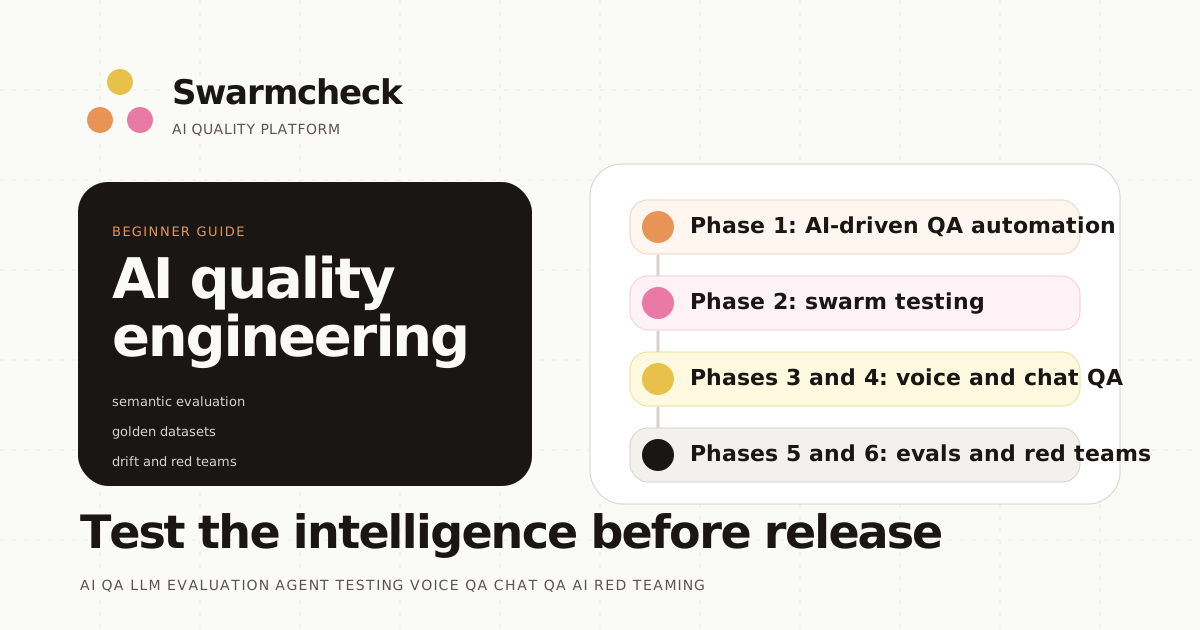
Swarmcheck AI is built as an AI quality platform for teams shipping AI-native products. Phase 1 starts with AI-driven QA testing, including auto-generation, self-healing, and browser automation. Phase 2 adds swarm testing, where AI agents test the product like real users.
Phases 3 and 4 layer in voice agent QA and chat agent QA. Phase 5 centralises AI quality, giving teams one place to evaluate, observe, and improve LLM applications. Phase 6 adds AI red teaming, including AI security and adversarial testing.
See how Swarmcheck brings autonomous QA, semantic checks, evidence, and release confidence into one product.
Explore how Swarmcheck agents run product checks across releases, production, and critical user flows.
A practical checklist for prompt regression, chat agent QA, voice agent QA, LLM evaluation, and AI red teaming.
How dynamic agent systems change the way teams think about verification, evals, and quality coverage.
Swarmcheck AI was founded by Naveen Bhati around a practical gap in modern software teams: mature QA tools can test screens, but AI products also need systems that test intelligence. You can connect with Naveen Bhati on LinkedIn.
If your team is moving from traditional QA into AI quality engineering, start with one risky AI workflow and make it measurable. To see how Swarmcheck AI can help, book a demo with Swarmcheck AI or try the Swarmcheck AI beta.
Point an agent at your worst flow.
The fastest way to find out if Swarmcheck fits your team is to run it against the flow you trust the least.