7 AI QA myths that make AI agents fail in production
A practical teardown of the AI QA myths that weaken release confidence, from prompt testing shortcuts to missing red teaming, voice QA, and LLM evaluation.
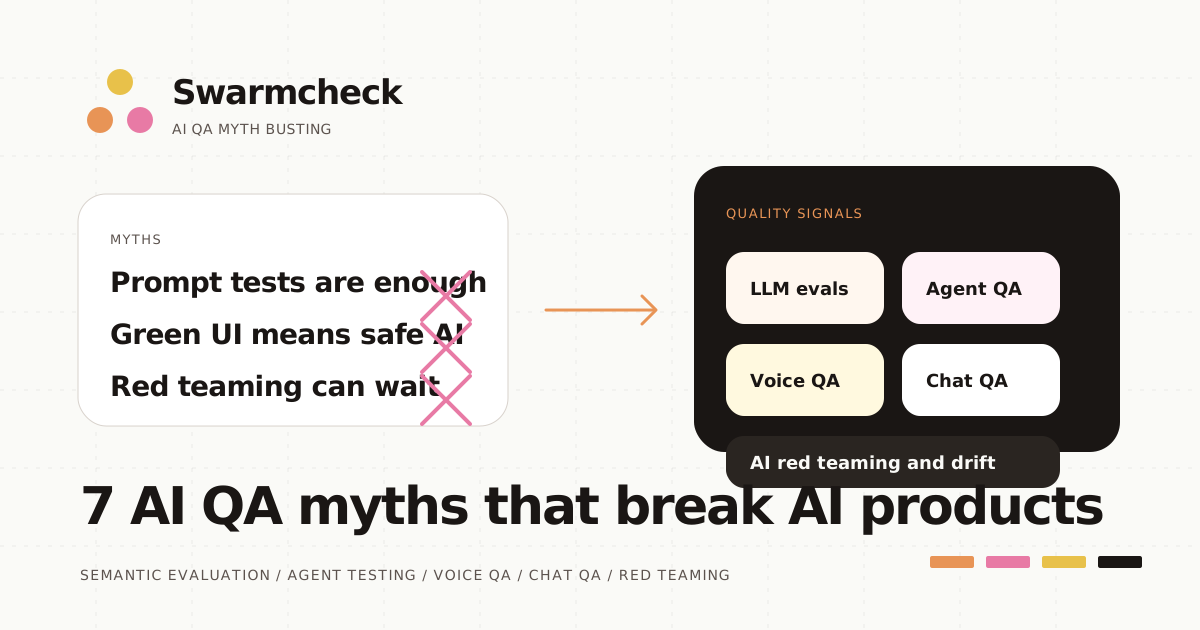
The most dangerous AI QA myth is that a product is tested when the workflow passes. For AI-native products, the page can work, the API can return 200, and the AI can still give the wrong answer with total confidence.
Traditional QA checks the flow. Swarmcheck AI checks the intelligence. That distinction matters because AI systems are non-deterministic, probabilistic, multi-turn, and prone to silent failures. If you are building agents, copilots, voice assistants, or support chat, AI testing has to evaluate behaviour, not just UI state. For the broader comparison, read Traditional QA is testing the wrong thing.
A deterministic test suite can prove that a path still exists. It cannot prove that an AI system made a good judgement.
What is AI QA really testing?
AI QA is the practice of testing whether an AI system behaves correctly, safely, and consistently enough for the user goal. It includes prompt testing, LLM evaluation, AI agent testing, voice agent QA, chat agent QA, production monitoring, drift detection, and AI red teaming.
The core shift is from exact-match assertions to semantic evaluation. A good AI quality engineering process checks grounding, hallucination, context retention, tone, refusal accuracy, latency, workflow completion, tool use, jailbreak resistance, prompt injection, and data leakage. Some failures are visible in a transcript. Others only appear after a model update, retrieval change, prompt edit, or real user edge case.
Myth 1: AI testing is just prompt testing
Prompt testing is necessary, but it is not the whole discipline. A prompt can pass a golden dataset and still fail inside a product workflow because the agent loses context, calls the wrong tool, ignores a policy, or takes too many steps to finish the task.
Use golden datasets and regression suites to catch prompt regression, but connect them to product-level checks. Swarmcheck AI starts with AI-driven QA automation in Phase 1, including auto-generation, self-healing, and browser automation. Phase 2 adds swarm testing, where AI agents test a product like real users rather than waiting for a brittle scripted path.
| Myth | Reality | Better AI QA check |
|---|---|---|
| Prompt tests are enough | Prompts regress, but workflows also fail through tools, memory, and state. | Golden datasets plus agent workflow completion. |
| One correct answer means quality | AI outputs vary across turns, context, and model versions. | Semantic scoring with calibrated rubrics. |
| A green UI test proves the AI worked | The container passed, but the judgement may be wrong. | LLM evaluation tied to browser automation evidence. |
| Security testing can wait | Jailbreaks, leakage, and injection risks are product risks. | Adversarial tests in every release gate. |
Myth 2: Traditional QA coverage is enough
Traditional QA is strong at checking deterministic flows: navigation, forms, API contracts, permissions, payments, and regressions in known paths. AI QA has to add another layer, because the risky part is often the generated decision. Did the chat agent invent a refund policy? Did the agent choose the right tool arguments? Did the voice agent recover after barge-in? Did the model refuse a harmful request without blocking a valid one?
This is where LLM-as-judge scoring can help, provided the judge uses a clear rubric and is calibrated against human review. The objective is not to replace engineers. It is to turn fuzzy failure modes into repeatable signals that can be tracked across releases.
AI QA metrics that actually matter
| System | Useful metrics |
|---|---|
| Chat agents | Goal completion rate, hallucination rate, refusal accuracy, context retention, tone consistency. |
| Voice agents | WER, time to first response, MOS, barge-in handling, accent robustness, escalation quality. |
| AI agents | Tool correctness, step efficiency, plan adherence, loop detection, workflow completion. |
| AI quality platform | Drift rate, regression delta, release readiness, alert volume, evaluation coverage. |
| Security testing for AI | Jailbreak success rate, leakage rate, prompt injection resistance, unsafe tool use. |
As the metrics above show, chat agent QA and voice agent QA overlap but are not interchangeable. Phase 3 of Swarmcheck AI focuses on QA for AI voice agents. Phase 4 layers in QA for AI chat agents. The channel matters because voice introduces speech recognition errors, accents, interruptions, latency perception, and conversational repair. Chat adds long-context behaviour, citations, tone, and turn-by-turn grounding. For an evaluation-focused companion piece, see The art and science of evaluating AI agents.
Myth 3: AI red teaming is a one-off audit
AI red teaming is not a launch-week ceremony. It is a continuous adversarial regression process. Every new tool, prompt, retrieval source, model version, policy, and integration changes the attack surface. A jailbreak that failed last month may succeed after a harmless-looking prompt refactor.
- Test prompt injection against user-controlled content, uploaded files, web pages, and tool outputs.
- Measure data leakage when the agent has access to private records, memory, or internal context.
- Track jailbreak success rate and refusal accuracy together, because over-refusal is also a product failure.
- Add adversarial cases from production incidents, support transcripts, and security reviews.
Phase 6 of Swarmcheck AI brings AI red teaming and security testing for AI into the same quality system as regression, observability, and release readiness. That is the practical difference between a checklist and an operating model.
Turn the myths into a quality system
The fix is not more manual spot checking. It is an AI quality platform that connects automated QA, swarm testing, LLM evaluation, production monitoring, and adversarial testing. Phase 5 of Swarmcheck AI centralises AI quality so engineering, QA, and product teams can evaluate, observe, and improve LLM applications from one place. Start with the AI Quality Platform, then use the AI QA White Paper to align your team around shared metrics.
Swarmcheck AI was founded by Naveen Bhati around a practical gap he sees in the market: teams have learned how to ship AI features faster than they have learned how to verify them. You can connect with Naveen Bhati on LinkedIn.
If your current tests only prove that the flow still loads, it is time to test the intelligence inside the flow. Book a demo with Swarmcheck AI to see how AI QA, AI agent testing, voice agent QA, chat agent QA, LLM evaluation, and AI red teaming can work as one release-confidence system.
Point an agent at your worst flow.
The fastest way to find out if Swarmcheck fits your team is to run it against the flow you trust the least.