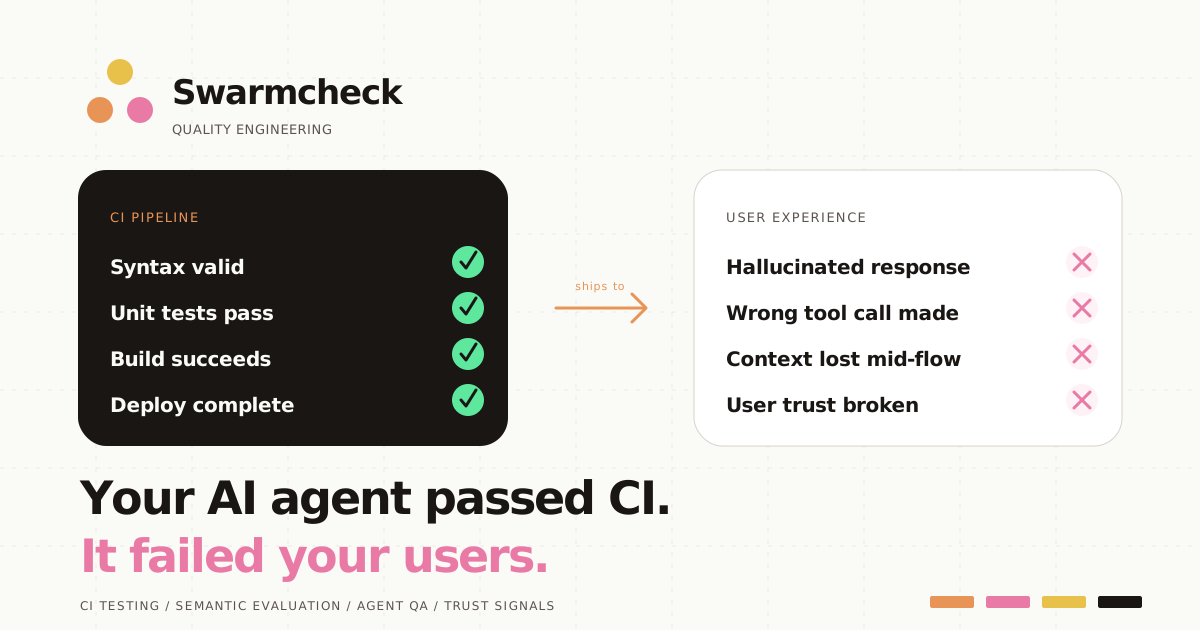
Your AI agent passed CI. It failed your users.
Vibe coding has made it possible to ship AI products in hours. The tests that come with them often pass. The quality that matters — whether the agent actually does the right thing — is the part nobody automated.
The speed gain from vibe coding is real. Teams that used to spend weeks on a feature now ship it in an afternoon. AI writes the boilerplate, fills in the logic, handles the tests, and opens the pull request. CI turns green. The deploy goes out.
The quality gap it creates is just as real — and it compounds in a specific way when the product you are shipping is itself powered by AI. When AI-generated code builds AI agents, chat assistants, and voice products, you are stacking two layers of uncertainty on top of each other. One layer is the implementation. The other is the intelligence.
CI measures whether the flow works. It does not measure whether the intelligence inside the flow is trustworthy.
What vibe coding actually ships
Industry data from 2026 makes the scale of AI-generated code impossible to ignore. New Relic's State of AI Coding report found that 67% of technology leaders say AI generates or significantly refactors between 51% and 75% of their organisation's weekly code output. Google has publicly stated that 75% of its production code is AI-generated. The median enterprise is operating in a codebase predominantly written by machines.
That pace comes with a hidden cost. The same report found that 78% of organisations report a measurable spike in production incidents directly tied to AI code, 82% have suffered at least one major production failure caused by AI code in the past six months, and 74% say at least 25% of all AI-generated code requires significant post-deployment rework due to poor context, incomplete data, or flawed system assumptions. AI-generated code introduces roughly 1.7 times more critical runtime issues than human-authored code.
For teams building conventional web applications, those numbers are a serious engineering problem. For teams building AI products — agents, copilots, voice assistants, support chat — the numbers are worse. Because the failures that matter most in AI products are not the ones that show up in CI. They show up in the intelligence layer. For deeper context on why this is a different category of problem, read Traditional QA is testing the wrong thing.
The two-layer quality problem
Vibe-coded AI products carry two distinct quality debts. The first is structural: missing edge cases, schema drift, integration failures, and the other runtime issues that AI-generated implementations introduce at a higher rate than hand-written ones. This is the debt that traditional QA tools were built to catch.
The second is behavioural: the AI product itself is non-deterministic, probabilistic, and prone to silent failures. A chat agent can hallucinate a return policy with total confidence. A voice agent can book the wrong itinerary while latency looks healthy. An autonomous agent can call the correct API with unsafe parameters. None of these failures show up as a failing test. None of them trip a deployment gate.
| What CI checks | What AI product quality requires |
|---|---|
| Does the API respond with 200? | Did the agent return a grounded, accurate answer? |
| Does the UI render correctly? | Did the agent complete the user's actual goal? |
| Do unit tests pass? | Did the agent maintain context across turns? |
| Does the build deploy cleanly? | Did the agent refuse correctly without over-refusing? |
| Are there syntax or type errors? | Did the agent call tools safely, not just correctly? |
| Does the health check succeed? | Did the agent's behaviour drift after the last model update? |
These are not complementary checks. They are tests for different things. The left column tells you the plumbing works. The right column tells you whether the intelligence inside the plumbing is trustworthy. Vibe coding accelerates the left column. It does nothing for the right.
Why standard tests miss the real failures
Standard tests verify the container, not the contents. The test says: does this endpoint return a response? Does this component mount? Does this workflow complete without an uncaught exception? For conventional software, these are the right questions. Correctness and function largely overlap.
For AI products, they diverge completely. A chat agent that confidently invents a refund policy, a voice agent that books the wrong date, an autonomous agent that calls a tool with a stale parameter set — these all return a response, mount cleanly, and complete without an exception. The container passed. The judgement failed.
A large-scale analysis of 20,574 coding agent sessions published in 2026 found that 90.5% of developer-agent misalignment episodes imposed measurable effort and trust costs. Of those that had visible resolution, 91.5% required explicit developer pushback. These failures were not detected by CI. They were discovered by the people using the product.
The container passed. The judgement failed. CI cannot tell the difference.
The silent failures that look like passing tests
Not every AI product failure announces itself. Most of them are quiet. Here are the categories that accumulate invisibly behind green pipelines.
- Hallucinated policy responses. The agent returns a confident, well-formatted answer that is factually wrong. The test sees a valid response. The user acts on a fabricated refund policy, a made-up feature, or an invented deadline.
- Tool call correctness versus tool call safety. The agent calls the right function. It passes parameters that are technically valid but contextually unsafe — a scope that is too broad, a record that belongs to the wrong session, an amount that exceeds any reasonable threshold.
- Context drift across conversation turns. The agent handles turn one and turn two correctly. By turn five, it has lost the constraint established in turn two and proceeds on outdated assumptions. Multi-turn regression is invisible to single-request assertions.
- Semantic drift after model updates. The prompt is identical to last week. The underlying model version changed. The agent now qualifies its answers differently, refuses a valid request it used to handle, or produces a tone that contradicts the product's voice guidelines.
- Over-refusal after safety tuning. A policy tightening was deployed to reduce harmful outputs. The agent now refuses a common, benign request that it handled correctly before. Users hit an unhelpful wall. The safety metric improves. The product quality metric declines.
- Plan adherence failures in multi-step agents. The agent executes the correct steps in the wrong order, skips a prerequisite action, or loops on a step it cannot complete rather than escalating. The workflow technically ran. The outcome was wrong.
The quality checks that actually catch these failures
The answer is not more unit tests. It is a different category of quality check — one designed for probabilistic systems rather than deterministic ones.
Semantic evaluation replaces exact-match assertions with rubric-based scoring. Instead of checking whether the response string equals an expected value, it checks whether the response is grounded in the provided context, whether the goal was achieved, whether the tone matches the product's voice, and whether the agent refused correctly. LLM-as-judge scoring can automate this at scale, provided the rubric is specific and calibrated with human review. For a practical framework, read The art and science of evaluating AI agents.
Swarm testing goes further. Rather than scripted paths, AI agents test the product like real users — exploring edge cases, trying unexpected input combinations, interrupting flows, and probing policy boundaries. Scripted paths test what the team expected. Swarm testing finds what the team did not expect. This is Phase 2 of the Swarmcheck AI product, and it is where the failure modes that deterministic suites never reach become visible and reproducible.
AI red teaming adds a third layer: intentional adversarial pressure. Jailbreak attempts, prompt injection via user-controlled content, data leakage probes across session boundaries, and harmful instruction escalations. Security pass rates for AI-generated code have remained flat at approximately 55% for two years despite rapidly improving functional correctness scores. Adversarial testing has to be a standing part of the release process, not a one-off audit.
The cost of discovering this in production
The price of discovering a software bug in production is engineering time and reputation. The price of discovering an AI quality failure in production is different. It includes the users who acted on a hallucinated answer. The sessions where context was lost and users gave up. The support escalations from an over-refusing agent that could not help. The trust that erodes when the product is confidently wrong.
These failures also compound across the vibe coding cycle. The faster the team ships, the more rapidly the agent's behaviour changes. Every new feature, every tool addition, every retrieval source update, every model upgrade changes the quality surface. A team shipping daily with AI-generated code has a quality surface that shifts daily. A weekly CI run and a monthly manual check is not a quality system for that cadence.
The organisations that are managing this well are not slowing down the shipping. They are building quality checks into the same velocity loop. Automated semantic evaluation on every release, swarm agents running against every production deploy, production monitoring tracking drift rate, evaluation coverage, and alert volume as first-class metrics. This is the approach described in the AI QA maturity model — matching quality investment to the release cadence and the user risk.
What to do about it this week
- Pick the AI workflow your users trust most. Identify what 'wrong but confident' looks like for that workflow — a hallucinated policy, an unsafe tool action, a broken context chain.
- Write three adversarial test cases: one that should trigger a correct refusal, one that surfaces a likely hallucination, one that tests context retention across at least three turns.
- Score them semantically, not by string match. Define a rubric in plain language: what does an acceptable answer look like? What disqualifies a response?
- Run these before every release. Monitor them after every model update, prompt change, or retrieval source modification.
- Add production monitoring for drift rate and evaluation coverage. A quality signal that only runs in CI and not in production is missing the most important half of the picture.
A tactical checklist for prompt regression, agent behaviour, LLM evaluation, and AI red teaming before every release.
A framework for measuring what frontier models get right, what they miss, and how to build evaluations that actually improve over time.
A practical five-level model for teams moving from ad hoc prompt checks to a full AI quality engineering system.
See how Swarmcheck combines semantic evaluation, swarm testing, production monitoring, and AI red teaming in one release-confidence system.
Swarmcheck AI was founded by Naveen Bhati around a practical gap he sees clearly: teams have learned to ship AI features faster than they have learned to verify them. The vibe coding acceleration is real, and it is not going away. The quality infrastructure that matches it is the part that still needs to be built. You can connect with Naveen Bhati on LinkedIn.
If your current tests only prove that the flow still loads, it is time to test the intelligence inside the flow. Book a demo with Swarmcheck AI to see how AI QA, swarm testing, semantic evaluation, and production monitoring can work together as one release-confidence system.
Point an agent at your worst flow.
The fastest way to find out if Swarmcheck fits your team is to run it against the flow you trust the least.